Showing posts with label #farming. Show all posts

Thursday, August 22, 2013

Harvest in the Palouse!

 
     It's harvest time all over the United States.  Harvest is an exciting time in every farming community.  It is the culmination of the farmer's entire year's work.  It is when he learns how well his or her plans and methods worked. It is when the farmer receives his paycheck, and hopefully he will have enough to pay his production expenses and be able to care for his family for the coming year.

A deer leaps across a ripened field of wheat.
Photo taken by Wade Lindquist at Bald Butte Ranch.

     Harvest is an intense time for farmers and their families.  There are long days of work.  There is not a minute for anything else - nothing else happens during harvest-time.  It's also a dangerous time for farmers; they're tired and stressed to the max.  They're frequently sleep deprived.  The weather may not cooperate; everything may be ruined by wind or rain coming at just the wrong time.  And, even though they may have maintained and repaired their machinery properly, they may still have equipment breakdowns, right in the middle of long harvest days.

Grain trucks ready to go.
Photo from Todd Strader, T & H Farms.

    
     For our farmers in the Palouse region of eastern Washington, harvest is one long event, beginning in late July and lasting through the middle of September.  They are just finishing harvesting their winter wheat which was planted last fall.  This includes soft white and hard red winter wheat.  They are harvesting their spring crops this week.  These includes the spring wheats - soft white, hard white and dark northern spring wheat.  Next to be harvested will be dry peas and dry lentils, finally followed by garbanzos.

Mark Richter combining wheat on St. John Farm.
The stalk and wheat head are pulled into the wide "header-bar" in the front of the combine.
Then the chaff (stalk and leaves) and wheat kernels are separated.
The chaff is spit out the back (that's the dust you see in the rear),
and the kernels are dumped into the big rectangular bin on top of the combine.

     Many farmers have just one combine, and harvest their own fields.  In other cases, they may share the work with other family members; their fathers, brothers, inlaws or their neighbors.  There may sometimes be more than one combine harvesting one field at a time.

Pumping the wheat kernels from the combine into the grain truck.
Note the two trucks behind, waiting to be filled.
 The wheat will be hauled to the grainery where it will
be sold for breads, pastries and noodles, all over the world!
     The schedule in most every case depends on the planting date and this season's weather.  In nearly every part of our country,  the rainfall is slightly different as one travels north to south.  Typically, the further north you go, the more precipitation you have. This is the case in the Palouse, so that means that the crop was planted earlier in the southern portion of the community, and so is harvested first.  Families and friends who are sharing the work of harvest work together to harvest the fields which "come off," or are ripened, first.

Three combines at work to bring in the harvest.
That's Todd Strader walking in his wheat field

Combines and tractors, all lined up for a
"Harvest is finally over" photo.
Taken on the Todd Strader Farm.
I think this is an especially beautiful picture, what with the sky and all.

    After a long, intense couple of months, the farmer has all his crops into the grainery.   Then he begins planning for next year!

EAT MORE WHEAT AND THANK A FARMER.


Thursday, August 1, 2013

Straight From the Farmer's Mouth

Here is another great video produced by the Washington Potato Commission featuring WA potato farmers. This video stars Farmer Jared Balcom of Balcom & Moe of Pasco, WA. He's talking to us about the widespread impact that that generations of farmers have on their communities and the world. Please enjoy and share.


Sunday, July 28, 2013

Notes From the Palouse

Rolling hills and patchwork farm fields
   
     This past week I visited the farmers who live and farm in the Palouse Region of Eastern Washington state.  This area comprises roughly in the south-east portion of the state, and goes into the panhandle of Idaho.  It is very rich agriculturally, with silty soils and abundant rains, which come during the spring and early summer.

Winter wheat beginning to turn from green to gold.  
     Geologically, the region is made of unusual and beautiful silt-dunes, which were formed during the Ice Age.  They were the result of a glacial outwash, which made huge, random humps and hollows.  I often describe them as endless giant gopher mounds.  The big, open portions of the dunes are cropped fields.  In the gullies and hollows, are timber, brush, creeks, deciduous trees and shrubs.  The combined fields and trees are gorgeous.

See how the cab is level, and the header follows the contour of the land?
This is a self leveling combine.  Pretty helpful.
     You might imagine that it could be dicey attempting to drive a tractor or combine on these steep hillsides.  It is!  The self leveling combine was developed by Washington State University, which is in this region.

      The farmland here is like none other.  Precipitation ranges from 15" to 22" annually, so farmers have no need to irrigate.  The top soil is very deep, ranging from 3' and deeper throughout the Palouse.  Crops are predominantly wheat, barley, dry peas, lentils and garbanzos, with some oats, flax and canola.  Whitman County, in the heart of the Palouse, is the largest grower of Soft White Wheat in the United States.

     The region was settled in the late 1800's by German, Irish and Russian immigrants - you'll hear their surnames all over the Palouse.  Most farms are still being worked by original families - with 4th and 5th generation now tilling the land that their ancestors homesteaded.

Fields with dry peas growing in the foreground

      Harvest is just beginning in the Palouse.  The first crop to ripen is winter wheat (hard red and soft white winter wheats), then dry peas and dry lentils, then the spring wheats (dark northern, hard white and soft white spring wheats), and finally, garbanzos.  Harvest runs from the end of July through September.

     After harvest, farmers plant their fall crop of winter wheat and in some cases, dry winter peas. Also, they prepare fields which will be planted in the spring.  They spray weed killer and incorporate fertilizer in the soil, so that it can work over the winter.  Usually they are done with all their fall work by mid to late October.

Dry peas growing.
     Then, they rest.  They  make repairs and upgrades to all of their equipment.  They go to seminars and conventions which pertain to the crops they grow, or type of farming they practice.   They plan and budget for next season, and talk with their banker, accountant and crop advisors.  They sleep in a little bit, maybe till 7 am or so.  They enjoy Thanksgiving and Christmas.  And, if they're lucky, they go on a winter vacation with their families and friends. The farmers of the Palouse know they live in God's country, and they don't take it for granted!


Thursday, July 11, 2013

Summer at Sweet Hills Farm

     The weather has really heated up over the past few weeks.  We had several nice, helpful rains the week before last, and now the warm weather has turned on.  Our farmer is irrigating non-stop, and the crops are growing, filling out and maturing.  I've snapped pics of wheat, sugar beets, corn and onion seed, on our farm and our neighbor's farm. (Our farmer farms both places).

The wheat on our place is getting tall,
the heads are filling out, and it is beginning to turn color
The field corn grows a couple of inches each day!
Seed onions - this crop is grown for the seed, which will be  sold to other farmers who will plant it
to produce onions for us to eat.  This photo was actually taken in early May, I forgot to post it.
The seed onions right now - the baby seeds are developing in those heads, or blossoms.
The blossom is the part of the plant which will be harvested.


Bees are brought in to pollinate the seed onion.  There are bees all over the place.

Wednesday, July 10, 2013

Farmer Profile - Mark Richter

     This month, we are happy to introduce you to Mark Richter of Endicott, Washington, located in the Palouse Country of Eastern Washington state.  We have worked with Mark since 1993; in that time, we have seen him become very progressive and conservation minded in his farming practices. Mark and his combine are featured in the header photo of our blog!

Farmer Mark Richter and his wife, Kathleen
Your name, family names and interests: 
     Mark and Kathleen Richter.  We have two daughters, Kayla and Claire, and a son, Colson.  Kayla is married to Eli, and they have a baby boy, Gavin.

Your farm name, and location:
     We are a family operation, and the name is R& R Farms, Endicott, WA

How long have you been farming?  
     I have farmed for 34 years.  I came back to the farm in 1979 after college

Why did you become a farmer? 
     I loved being out on the land and being my own boss.
 
What crops do you grow?
 We grow Soft White Winter Wheat, Hard Red Winter Wheat, Hard Red Spring Wheat, Soft White Club Wheat,  Peas, Lentils and Garbanzos


Mark Richter's farm from the air

What type of farm do you have?
      Our region is all dryland, meaning we don't irrigate.  We are a Direct-Seeded producer.  This means we don't plow, disc or cultivate the soil, but plant directly into last year's stubble.  We don't raise any livestock.

Tell us about your operation. 
     We are an all grain and legume farm. We are in the Palouse country, which in the southeast portion of Washington State.

Do you use any sustainable practices?   Please tell about them.
     We have been direct seeding 100% of our operations continuously since 1997.  In the Palouse our terrain is very hilly, we can get to over 50% slopes which creates unique challenges for equipment and operator. 

     Within that challenge we receive most of our precipitation in the winter, which has very erosive affects when the land is not properly cared for. The traditional practice of summer fallow using tillage to combat the weeds would give us water erosion of more that 200 tons per acre*. That practice is not sustainable, which is why we went to direct seeding.  Direct seeding is also known as no-till. That is where the crop is planted into the previous years stubble with one or two passes across the field, to fertilize and plant the crop. We have eliminated erosion on our farm and we are trying to be the best stewards of the land that we have been blessed with.

Something interesting, cutting-edge, fascinating, you would like readers to know?
     We have been using GPS for guidance and automatic boom shutoff for the last 10 plus years. It has been a real money saver and also good for the environment. It shuts off valves that apply fertilizers so that they are not being over-applied.

During last summer's wheat harvest
What are the biggest challenges you face as a farmer?   
     The biggest thing we deal with are regulations and red tape from special interest groups. We are the only industry that produce goods that sell for wholesale and we pay the freight both ways.

What are farming’s biggest rewards for you? 
     I wake each morning to a new day that has a new set of rewards and challenges. I appreciate the beauty of each and every sunrise and sunset, and the ability to be in God’s creation.


Do you participate in any civic or industry organizations?   
     Yes, I’m a member of the Washington Farm Bureau, Washington Association of Wheat Growers and the Pacific Northwest Direct Seed Association (PNDSA). I served as the President of the PNDSA which is a three-state organization that encourages farmers and industry to wise stewardship of our resources. Website: www.directseed.org


*Water erosion of more than 200 Tons per acre means that the rain and/or frozen soil conditions have allowed the loss of 400,000 lbs. of soil to be moved from its original place.  This could be down to a lower draw where it flattens out, or further down stream into our creeks, rivers, lakes and/or reservoirs.


Sunday, June 23, 2013

Field Trip to the Amish Country

     This past week, my cousin, Cynthia and I met in Philadelphia for a few days.  Cynthia is a true-blue city girl, hailing from Southern California.  But, because she loves me, she reads this blog regularly.  She says she's learned a few things, gives regular feedback and asks questions, which is most gratifying, and is what this blog is all about.

Breathtaking vistas in every direction

     So, before our trip, we were planning the sites we would visit.  I had been thinking early American history, quill pens and cracked bells.  Then Cynthia piped up and said, "I want to see the Amish Country!"

     Wow!  Now you're preaching to the choir, Cuz!  We hopped into our rental car and zipped west on highway 30 toward Strausburg.  Then we cut south from there on little winding roads.

Huge Amish farmstead, neat as a pin.
You can't seem him in the shadows of the silo,
but there is a man ground-driving a pair of draft horses
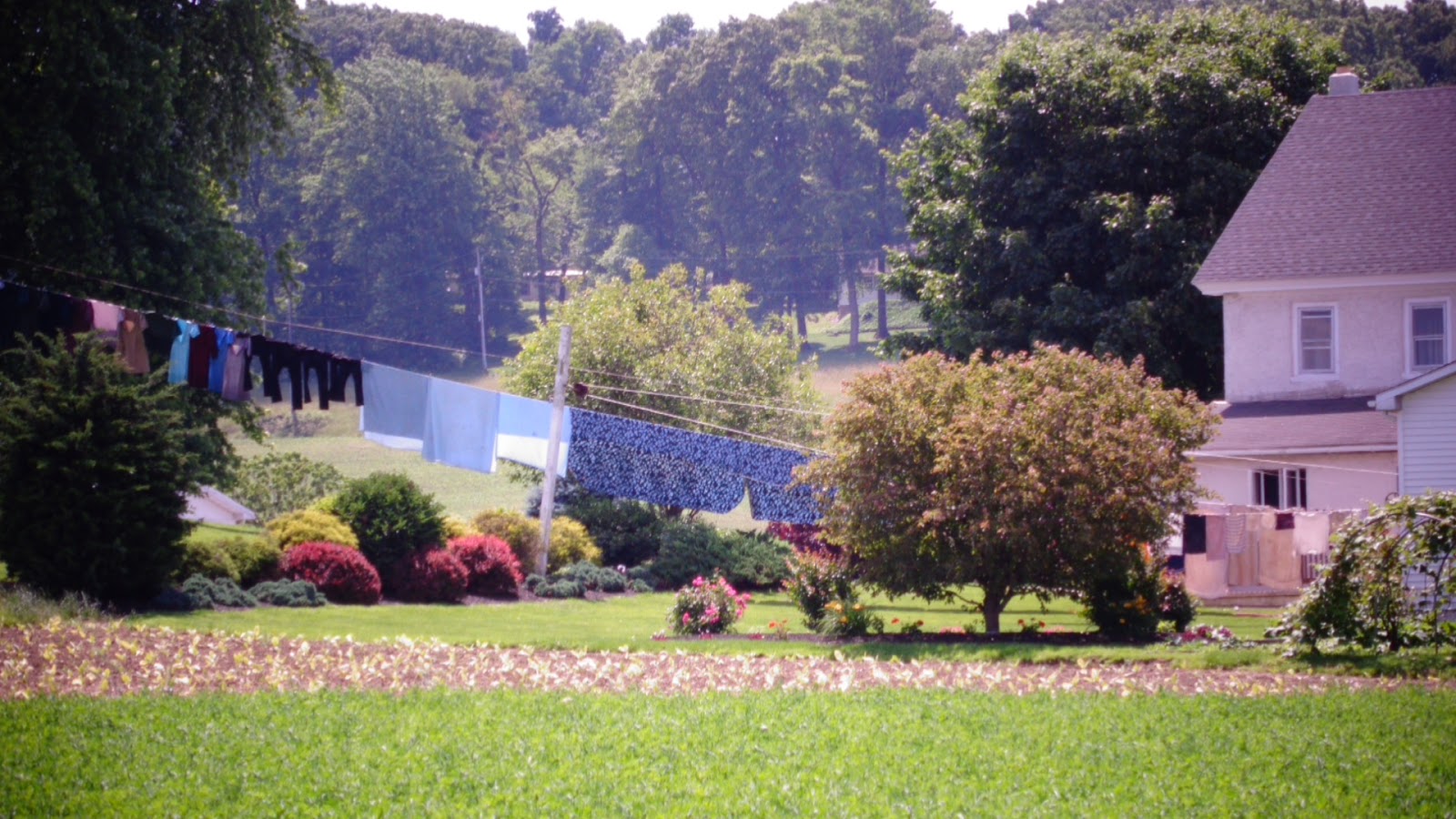
     If you are going to introduce a city person to the farm, I can't help but think a good choice is a visit to the Amish Country.  Lancaster County is the quintessential farm scene, with far reaching vistas at every turn.  The terrain is rolling, there are copses of deciduous trees here and there.  Little creeks tumble by, and there are bridges, some of them covered, all around.  On and on are dotted picturesque farmsteads, with huge white barns, silos, windmills, gigantic houses, laundry on the line, children playing outside, pretty flowers at the driveway and cows grazing in the pastures.

     And horse poop on the roads.

     Horses working in the fields.

     Horses pulling buggies.

     Everywhere.

     Not a tractor in sight.

     Not an electrical line in sight (at least not to the Amish homesteads).

     It was fantastic.

Driving 4-Abreast.  You don't see that very often.
     Farming here is done with horse and implement.  Smaller fields.  No irrigation - God sends the rain at the right time.  Their yields are abundant, the quality of their crops, excellent.  However, they aren't producing food for the world, only for their families and to sell within their community.  Most Amish farms are 50 to 80 acres each.  As families grow and sons then have families of their own, they will try to acquire more land.  This is difficult though, because there is only so much farmland, and there are many sons who wish to farm.  Nevertheless, farming is an old and strong tradition in Amish country, with two, three and sometimes four generations farming together, and living under one HUGE roof.   


Moving equipment from one field to another.  You see this all the time
in farming country, only usually it's tractors.


Setting out tobacco seedlings
Typically, Amish farmers use manure from their livestock (cows, horses, pigs and poultry) to fertilize their fields.  They spread the manure onto the fields with a manure spreader in the fall and early spring. They will supplement the manure with commercial fertilizers if they feel the soil needs it.  They try not to use pesticides, but instead depend on beneficial insects and crop rotation to battle insects.  This sometimes does not work, and the crop may then be diminished.  The typically don't use herbicides (weed killers), but will if they have an invasive weed which they cannot combat with cultivation.  In short, by their nature, Amish farmers grow their food naturally, but are practical, and will use conventional methods if helpful.

Cultivating tobacco.  This guy was ASLEEP!
     The crops we saw were alfalfa hay, corn (both for cattle feed and humans), tobacco, wheat and oats.  Also, there is a lot of pasture ground here.  They usually graze their livestock as much as possible.

     This time of year, farmers are cultivating their corn and tobacco, cutting, raking and baling hay.  We saw one family setting out young tobacco plants in a field.

Mares and foals. 
    I think if I was Amish, I would raise horses - now that would indeed be heaven for me!  We saw a pasture of grazing draft mares and foals.  (draft horses are the big horses which pull heavy farm equipment, wagons and the like).  This was a horse breeding farm, raising and training draft  animals for the community.  Kind of like our local John Deere manufacturer or dealer.

Buggy leaving the dry goods store
  
     We happened upon a dry goods store.  It had a hitching rail in the parking lot, with two sets of buggies and horses tied up to it.  In the store were kitchenwares,  books, domestic items of all sorts, cleaning supplies, clothing and fabric.  They had a enormous stock of black fabric (which is what every person wears everyday, along with a solid colored dress or shirt).  Their solid fabrics ranged from pastels to jewel tones.  In the back of the store were rack upon rack of ready-made clothing - all in black.  Pants with suspenders for boys and men, pinafores for girls, capes and bonnets for women.  All of these clothing items looked like they had been handmade, and had no zippers or velcro.  This store was for women, and had no farm supplies and the like.    


Farmers' Market with 5 buggies!
    
Buggy horses hanging out in the shade while their masters
are at the farmers' market
      There was a Farmers' Market, too.  This one had 5 buggies parked out front, irresistible!  There were Amish-farmwife-made jams, Whoopie Pies, breads and fresh-from-the-garden strawberries.


     While the Amish may live a "simple" lifestyle, and their farm acreages may not be huge, nor may their yields be the top in the U.S., it sure looked like it was working well.  Every single farm we saw was spotless and beautifully maintained, with fresh paint and lovely trees.

Laundry on line - in nearly every yard.
     But the best part was that Cynthia appreciated it.
    I think maybe we have a new Advocate for Agriculture, Cuz!

Happy Cousins

Note:  Many of the photos in this 
post were submitted by Cynthia.


Monday, June 10, 2013

Farmer Profile - Guy Therrien

  This month, we are very pleased to introduce you to Farmer Guy Therrien of the Palouse Country, located in Eastern Washington state.  He and his wife, Jeanne, (a fourth generation farmer), work with her father, Allan Hood.
The Therrien Family,
back row:  Guy, Tanner, A.J. & Josh,
front row:  Jeanne & Jillian

     My name is Guy Therrien.  My wife, Jeanne and I have three boys.  Josh is an athletic trainer for Oregon State University.  He is married to Jillian.  Our second son, A.J. is a senior at Washington State University, studying Construction Management.  Our youngest son, Tanner, is a junior at Pullman High School, and a recent state champion in basketball.

     We live and work in the Pullman, Washington area.  I married into my wife's family's farming business 23 years ago.  I work with her and her father, Allan Hood.

The vineyard along the Snake River
   
     When we aren't working, we enjoy fishing, hunting, hiking, watching our kids play sports, and watching WSU (Washington State University) Cougars sports.

     We have a hobby vineyard in the Snake River Canyons.  Our vineyard has eight - 200' rows.  Four of the rows are Cabernet Sauvignon and four rows are Shiraz grapes.  The vines are about 9 years old.  We trade the grapes for wine from Wawawai Canyon Winery.  It's a pretty good deal!


Cabernet grapes
     On our dryland farm, we grow red and white wheat, barley, peas and garbanzo beans.  We try to farm in a three year rotation with these crops.  Winter wheat is followed by a spring grain (wheat or barley) the second year,  and then a pulse crop (dry green peas or garbanzo beans) the third year.  This helps in our weed and disease management.

     Since I started 23 years ago, so much has changed.  The obvious changes are in the machinery we use.  It's larger, faster, and so much more technologically advanced now.  Our tractors have navigation, speed control, auto steering, four wheel drive, etc.  This adds a little more to the production costs.

     Less obvious changes have happened in our farming practices.  We no longer plow or disk the soil.  We have put grass strips in highly erodible places, and we till the ground very few times.  These practices have virtually eliminated erosion.
Oops!

     I feel that our biggest challenges are the same as they have always been.  We have to sell our crops for more than we have invested in them.  We receive a higher price for our crops these days than 10 or 20 years ago, but our costs have increased also.

     The most satisfying rewards happen at the end of harvest.  All the difficult decisions, spending, sweating and sleepless nights have produced a finished product that helps feed the world, and hopefully, we have earned a little profit.

Lucky the Llama
     We are members of the Washington Association of Wheat Growers and the U.S. Dry Pea and Lentil Association.

Friday, June 7, 2013

#10 - Pinto the BlogDog - Doin's on Sweet Hills Farm


That's me, waitin' for some action.


      HOWDY FOLKS!  Pinto the BlogDog here.  How're ya all doin'?  It couldn't be prettier here today.  The sun is shinin', it's about 88* outside, and there is not a cloud in the sky.  This is crop growin' weather!  It was rainy for a coupla weeks, which was good - the land was desperate for rain.  The farmers were very happy for the rain to come.  But now, the growin' plants need warmth and sunshine!


     Now, ya know, on a farm, spring and summer are busy times.  In the spring, the farmer has to prepare the soil for planting, then he plants the little seeds, and then he fertilizes 'em.  But, now that the crops are planted and fertilized, the farmers are cultivating and irrigating the little plants.  They irrigate, irrigate, irrigate, the crops grow, grow grow, and then comes harvest.  In the farm-shops they're fixing the tractors, harvesters and cultivators - greasin' and getting' 'em all tuned up.  But here in my yard?  It's Q-U-I-E-T.

The wheat has grown a lot in the last coupla weeks,
what with the rain and  sunshine.
That white bar at the bottom is the irrigation pipe.

     I mean, have you ever watched crops grow?  Ya can't hardly see nothin' happ'nin'!  But the farmer,  he checks his crops every single day.  He watches over 'em.  He coddles 'em.  He touches their leaves and stems, he peeks at 'em, digs in the soil and rolls it around in his hand to check for moisture.  He looks up at the sky, he stares at the wind.  All day.  Every day.  All summer long.

Wheat being irrigated.  See the heads that have formed on the top of
each plant?  That's where the little wheat kernels are growing,
getting heavy and plump, and full of nutrition.

     I mean, really?  But, M'Lady reminds me that the farmers' crops are important to him, they are his lifeblood, they are his everything!  He plans all year for them, he loves his crops, he grows 'em and harvests 'em, and then sells 'em to feed you and me.  He does all this 'cause he loves to farm, he loves the land he cares for, and he feeds and cares for his family, too.


Sugarbeets are comin' right along.

     So this is what's goin' on:

     The wheat is growin'.

     The sugar beets are growin'.

     The pasture grass is gettin' gosh-durned tall.

     The hired man comes every day to irrigate the crops.

     The farmer comes every day and s-t-a-r-e-s at the crops.

     The sugar beets are being cultivated.

     The horses are grazing.  That's all they do.  Heads down, eat, eat, eat.

     That's it.

     Huh.

Merrygold in her grazing muzzle and flymask.
     One thing interesting is that Merrygold has to wear a grazing muzzle, 'cause she gets like a porky-piggy-tanker if she doesn't have one on.  The muzzle has a little hole in the bottom, see, 'bout the size of a half-dollar.  She can reach about 20% the amount of grass she would eat without the muzzle.  This way she gets to be out in the pasture with Roxie, otherwise she would have to stay in the corral.  She's happy, eats all day long, and she stays svelt like YoursTruly!  M'Lady tells Merrygold that she wishes someone loved her enough to put a grazing muzzle on her!  Hahaha!

     Oh, and the horses both wear flymasks.  That's what's on Merrygold's eyes.  It keeps the flies out of her face, the sun, dust and wind, too.  Pretty helpful.

     Well, gotta go.  It's dinner time!  Y-A-Y!!!  Dinner time!  Dinner time!  Dinner time!  The best time of the day!  (other than breakfast-time).  Catchya later!

     Keep your tail waggin'!

Sunday, June 2, 2013

Notes from Pasco & The Columbia Basin, Washington

     Last week, I visited the farms and farmers in Pasco, Washington.  Pasco is located in south-central Washington state, at the southern end of the great Columbia Basin.  It is bordered to the west by the mighty Columbia River, which is the main transport for crops and commodities to the west coast.  They are barged downriver to Portland, Oregon, where they are then shipped to points all over the world, especially the Pacific Rim.

The pivot of a center pivot irrigation system or "circle" for short
Circles have revolutionized irrigation for farmers

The Columbia Basin is irrigated by the gigantic Columbia Basin Project (CBP) irrigation network which originates in northeastern Washington.  It is the largest reclamation project in the United States, supplying water to over 671,000 acres of farmland.  The water originates on the upper Columbia River, and is held in reservoir by the Grand Coulee Dam.  This dam project was part of President Roosevelt's new deal.  Construction on the dam began in 1933 and was finished in 1942.  The lakes resulting from the dam are Banks Lake and Lake Roosevelt.

     The irrigation water is held in reservoirs throughout the basin, sometimes called "potholes", and is then delivered to the farm fields by way of 331 main canals, 1,339 miles of lateral canals, 3,500 miles of drains and wasteways.  Wow!

A lateral canal delivering water to a farm
        Because this is a relatively new and modern irrigation system, the land has been divided in larger, more uniform-shaped fields, ranging in size from 50 to 150 acres each, as compared with older systems which have smaller and often irregularly shaped fields.  The climate of south central Washington is arid; natural rainfall here is 7" per year.  The Columbia Basin Project turned desert into some of the most productive farmland in the country.

A field of beautiful timothy hay.
This will be cut two times this year, and baled as hay for horses
Look at that pretty sky!
    Columbia Basin farms grow an endless variety of crops.  Alfalfa and timothy hay, potatoes, dry beans, onions, garlic, buckwheat, sweet corn, fresh peas and beans.  Grapes for wine and the table, as well as all number of other fruits including cherries, pears, apples, peaches, nectarines, walnuts - all are grown on a commercial scale.

Potatoes for you and for me!  They're coming along nicely.

Our Pasco farmers are busy this time of year.  All of their crops have been planted, and have emerged from the ground. The first cutting of alfalfa hay is underway, and unfortunately, much of it was rained on.  Here are some photos for you to enjoy.

Haylige.  Like silage, only hay.  This was harvested in 2012,
then set all winter in the plastic wrap, which fermented it.
The milk cows love it, and it provides super-nutrition for them too.

John Deere tractors all lined up, ready for work

The tractors pull these hay-balers, to bale alfalfa and timothy hay


Thursday, May 23, 2013

Spring Updates from Farmer John Sturtevant

Hello Everyone! John Sturtevant has sent us a note about spring on his farm. You'll be interested to see all the different things that farmers have to think about. It's a whole lot more than planting, praying for rain, and harvesting!

From John:

This spring is going well. The weather has been a bit of a roller coaster. Really warm temperatures in March had us thinking it would be an early cut year [for alfalfa], but was followed by a cold April. Now, 90+ degrees this week after we had frost three days last week. Some pretty wild swings! The warm weather is great for helping the hay catch up on some growing it needed. Very little rain this spring. The dry land wheat guys must be nervous.

I plowed out the east 60 acres this week in preparation to plant red beans at the end of the month/beginning of June. We start cutting alfalfa on Monday. Tonnage for the crop looks like it will be ok.

The price for first cutting alfalfa is forecast to be somewhat down from 1st cutting last year - maybe $10 to $20 per ton. There is still some of last year's hay sitting around which is depressing the dairy market [dairies buying hay].

The export hay market was slow, then it got even slower when Japan began manipulating their currency in much the same manner that the U.S. has in the past 4 years. This has made the dollar/yen ration unfavorable for exports to Japan.

It looks like the bean market is holding steady. I guess everybody is waiting to see what the corn market does. If a record corn crop comes off this fall as some are prediciting, then prices for most commodities will fall. One negative weather event could change that, though. I heard one analyst say that we are entering into a three-year down-cycle in commodity prices as world stocks increase.

I think snowpack in the mountains as adequate this winter, so there shouldn't be any water problems here.

That's the end of John's report.

See? Farmers have to think about national and international commodity markets, currency fluctuations and exchange rates, and a whole bunch more!

If you have any questions for John about his operation, how he makes is plans for the year, or anything else, please feel free to ask in the comments section!

Monday, May 20, 2013

The Farm Bill

     We hear the word "Farm Bill" in the news.  But what is it, and what does it mean?  We've heard the media say that it is "farmer welfare," and "farm supplements."  We've heard that American farmers are paid to not farm, that the government pays them for their crop.  What we don't hear is that over 2/3 of the farm bill doesn't deal with farming and conservation at all, but is for foodstamps.

     The Farm Bill should really be two different bills.  It should be the "Foodstamp Bill", and the "Farm Support and Land Conservation Bill.".  The provisions in our current Farm Bill are for wildly different purposes.

     On the pie chart at the right, you see that 69.40% of the 2008 Farm Bill provides for foodstamps.  This is the current Farm Bill which we are working under now.  The new 2013 Farm Bill is being negotiated by the Senate Agriculture Committee at this time.

     The official term for foodstamps is "Supplemental Nutrition Assistance Program," or SNAP.  Between 2002 and 2012, the number of participants in SNAP increased from 19.1 million to 44.7 million people, and the total program cost went from 16.3 billion to 74.6 billion dollars.  (Capital Press, 5/17/2013)

    But that's not what this article is about.  We're here to talk about the other 30.6%.

     Many of the foods grown in the US can be grown in other countries.  Examples are wheat, corn, soybeans, rice, among many, many others.  These crops are called commodities, and they are traded globally, with the price set not locally or even nationally, but on the world market.

     In our country, We, the People, demand that our food be safely grown, and that our farm laborers be paid fairly and treated fairly.  This increases our American farmers' cost to produce food.  At the same time, much of the food we eat can be grown in other countries, and those countries may not have the same safety and humane standard as we have, so the cost of production there is quite a bit less.

     For this reason, in the Commodities segment of the Farm Bill, we supplement our farmers when the commodity price falls below a certain, established price.  For example, say it costs the American Farmer $4.50 to produce a bushel of wheat, and that same bushel might cost $3.00 to be grown in South America or Egypt.  What if, due to the world economy and global trading, the price of that bushel falls to $3.75?  Our farmer is losing quite a lot, and still must use the more expensive, but safe chemicals.  He must still provide his employees with Worker's Compensation insurance, pay a fair wage, and provide a safe work environment.  The Farm Bill then kicks in and compensates him for that extra cost to produce that bushel of wheat.

      The next category deals with loss of crops.  A farmer has a "base yield" on his farm.  He registers each year's yield with his local USDA agency, and a 5 year average  of his yields is kept by them.   If, due to weather, (fire, wind or hail) his crop lost or is less than that base, The Farm Bill agrees to reimburse him for that loss.  This is Crop Insurance.  It should be noted that Federal Crop Insurance is not just handed out - each year a farmer pays a premium for this insurance in order to have the option to participate in it.

     The next category is Conservation.  Our farmers and ranchers are the ones who manage almost all of the privately and much of the publicly held land in our country.  There are numerous programs to assist farmers and ranchers in improving their operations, to make them more environmentally sound. An example of this is the Conservation Reserve Program (CRP).  In this, the farmer agrees to remove environmentally sensitive land from agricultural production, and plant species of plants and grasses that improve environmental health.  In exchange for this, the farmer is paid an annual rental payment for a 10-15 year period.

     Additional examples of conservation programs:
     -converting high-pressure sprinklers to low-pressure, using less water and power, and watering the crops more efficiently
    - planting trees and shrubs to form windbreaks which reduce erosion.  They also would provide habitat for birds and small animals
    - developing springs and water-ways to provide drinking water for livestock and wild animals and birds
    - protecting waterways from livestock
    - planting native grasses and plants in un-cultivated areas to provide habitat for animals

     The small category of Energy  deals with helping farmers and ranchers make their operations more energy efficient.  A few examples of the programs would be: updating irrigation systems, re-winding pumps so that they run more efficiently, upgrading equipment to be more fuel efficient, insulating shops and barns so that they use less electricity for lighting, heating and cooling.

     The category of Exports provides funding for international agriculture trade programs, and developing international access to American farm products.  One program is called Market Access Program (MAP) in which the USDA matches dollars for foreign market development.

     So now, you have a better understanding of the Farm Bill (or should I say the Foodstamp and Farm Support and Land Conservation Bill).   Also, hopefully you can better understand the media when you hear discussion about The Farm Bill.


Thursday, May 16, 2013

What About Wheat

Ancient Egyptian mural - wheat harvest
Wheat is an ancient, ancient grain.  Wheat is mentioned in the Bible, Quran, Torah, Greek and Roman mythology, and the Epic of Gilgamesh. Wheat kernels have been found in ancient ruins around the world, and found its way into the bricks of the pyramids in Egypt.

To the best of our knowledge, it was the first grain ever cultivated for food. This member of the grass family originated somewhere in the Eastern Mediterranean or Middle East as early as 9000 BC, and possibly long before that. It spread throughout the region, and reached Europe around 5000 BC. The first identifiable wheat with gluten enough for yeasted breads emerged around 1350 BC in Greece.

Wheat was first planted here in the United States in 1777, and is now the main grain used in grain products, such as bread, crackers, and pastas. Wheat is grown in 42 states, with farmers producing about 2.4 billion bushels of wheat on 63 million acres of farmland. One acre of farmland will produce an average of 40 bushels, which is generally 60 pounds of wheat. More fun facts: one bushel contains approximately 1 million kernels of wheat, and will yield 42 pounds of white flour or 60 pounds of whole wheat flour. That's a lot of wheat!!

As you can probably guess, the Mid-West holds some of the nation's largest producers of wheat, with Kansas in the #1 spot, with North Dakota comes in second. Kansas also produces the most milled wheat in the US.  Kansas produces enough wheat each year to bake 36 billion loaves of bread and enough to feed everyone in the world, over six billion people, for about 2 weeks. An acre of Kansas wheat produces enough bread to feed nearly 9,000 people for one day. Way to go, Kansas!

Geographical location of wheat growers and varieties in the USA

There are thousands of varieties of wheat grown in the USA and around the world, ranging from old heirloom varieties to modern wheats specially grown to fight off pests and thrive in arid climates. Each variety of wheat will fall under one of six classes: hard red winter (HRW), hard red spring (HRS), soft red winter (SRW), hard white (HW), soft white (SW) and durum.

Winter wheat is sown in the fall and emerges before the frost, where it winters under the snow, and grows in the spring and summer. It is harvested before spring wheats, which are planted in the spring. Winter wheats typically have higher yields than spring wheats.

Hard Red Winter wheats have harder kernels, and are brownish in color. They have high-protein content, and are used for bread, hard baked goods and in other flours to increase protein in pastry flour. HRW accounts for almost 40% of the US wheat crop. Hard Red Spring wheats have hard, brownish, high-protein kernels used for bread and hard baked goods. Bread Flour and high-gluten flours are commonly made from HRS. Soft Red Winter wheats have softer kernels, and are lower in protein. SRW wheat is used for cakes, pie crusts, biscuits, and muffins. Cake flour, pastry flour, and some self-rising flours are made from soft red winter wheat.

Taken from the U of I College of Agriculture's website
Hard White wheats have hard, light-colored, opaque, chalky kernels, and  medium-protein content. HW wheat is planted in dry, temperate areas, and used for noodles, yeast breads, and sometimes brewing.

Soft white wheat is a soft, light-color kernel with very low protein content. SW wheat is grown in temperate moist areas,  like the Northwest.   Eastern Washington and Northern Idaho are the largest producers of SWW in the US.  SWW is used for pie crusts and pastry flour, and much of what is grown in our region is shipped to the Pacific Rim for their specialty noodles.

Finally, Durum wheat  kernels are very hard, translucent, light-colored, and used to make semolina flour for pasta and bulghur. Durum is high in protein, specifically gluten protein.

Semolina is used in making pasta, cereals, puddings, and couscous. It is the coarsely-ground, purified wheat middlings, which are the starches separated from the wheat bran and germ. Semolina can be made from other grains as well. For example, corn semolina is more commonly called grits! Bulghur is a cereal made from the groats of wheat. Groats are the hulled grains of wheat which have been cut into fine, medium, or coarse textures. Basically, groats are the kernels just cut up to make using them a little easier. Bulghur is used in many dishes, such as pilafs, mainly in the Middle East and India.

Wheat is a very versatile crop, and different varieties can be grown in wetter environments, as well as in arid climates. The biggest producer of wheat worldwide is the European Union, followed by Russia, the US, China and India. Rising demand for wheat in Asia has led to increased production and export by these countries, and the opening of new regions for wheat production, specifically the countries located around the Black Sea.


Wheat Harvest in the Palouse

Better seed storage and germination ability is a 20th century technological innovation. In Medieval England, farmers saved one-quarter of their wheat harvest as seed for the next crop, leaving only three-quarters for food and feed consumption. By 1999, the global average seed use of wheat was about 6% of output. Wheat kernels travel well, and in the right environment can remain intact for years, millenia, even! Wheat can be prepared a myriad of ways for human consumption, and is also often used as animal feed. Whole wheat's high protein and fiber contents, along with good amounts of other important vitamins and minerals, make this grain a very, very important part of the diet of people across the world.


Information for this article was taken from these sites:
http://www.wheatworld.org/
http://wheatfoods.org/
http://en.wikipedia.org/wiki/Wheat
http://en.wikipedia.org/wiki/Semolina